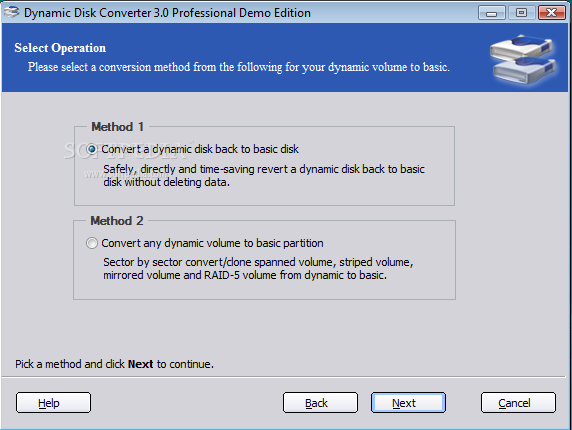
A powerful dynamic disk management software.
Dynamic Disk Converter is a handy disk management application that can convert a dynamic disk to basic disk without loss of data. After completing the conversion, it can ensure Operating System bootable and data integrity. Its friendly user interface makes you use it more easily and efficiently and its high security makes your data be protected during the conversion process.
Here are some key features of "Dynamic Disk Converter Professional":
· Convert an invalid or unreadable dynamic disk to basic disk.
· Support spanned volume, striped volume (RAID 0), mirrored volume (RAID 1) and RAID 5 volume convert (clone) to basic partition.
· Ensure system bootable after reverting dynamic to basic disk.
· Ensure data security during the conversion process.
· Support a single disk and volume with the maximum capacity of 2TB.
· Support for FAT, FAT32, NTFS, exFAT and others (e.g. ext2, ext3) file systems.
· Friendly user interface makes you use it more easily and efficiently.
Limitations:
· You can verify whether it is able to complete the desired conversion
Here are some key features of "Dynamic Disk Converter Professional":
· Convert an invalid or unreadable dynamic disk to basic disk.
· Support spanned volume, striped volume (RAID 0), mirrored volume (RAID 1) and RAID 5 volume convert (clone) to basic partition.
· Ensure system bootable after reverting dynamic to basic disk.
· Ensure data security during the conversion process.
· Support a single disk and volume with the maximum capacity of 2TB.
· Support for FAT, FAT32, NTFS, exFAT and others (e.g. ext2, ext3) file systems.
· Friendly user interface makes you use it more easily and efficiently.
Limitations:
· You can verify whether it is able to complete the desired conversion

| Developer: License / Price: Size / OS: Last Updated: Category: | Dynamic Disk Converter Development Team Demo / USD 29.00 1.9 MB / Windows 2K / XP / 2003 / Vista / 2008 July 4th, 2010 Utilities |
Click To Download
Dynamic Disk Converter Professional 3.1